

 Dec 28, 2025
 3 min read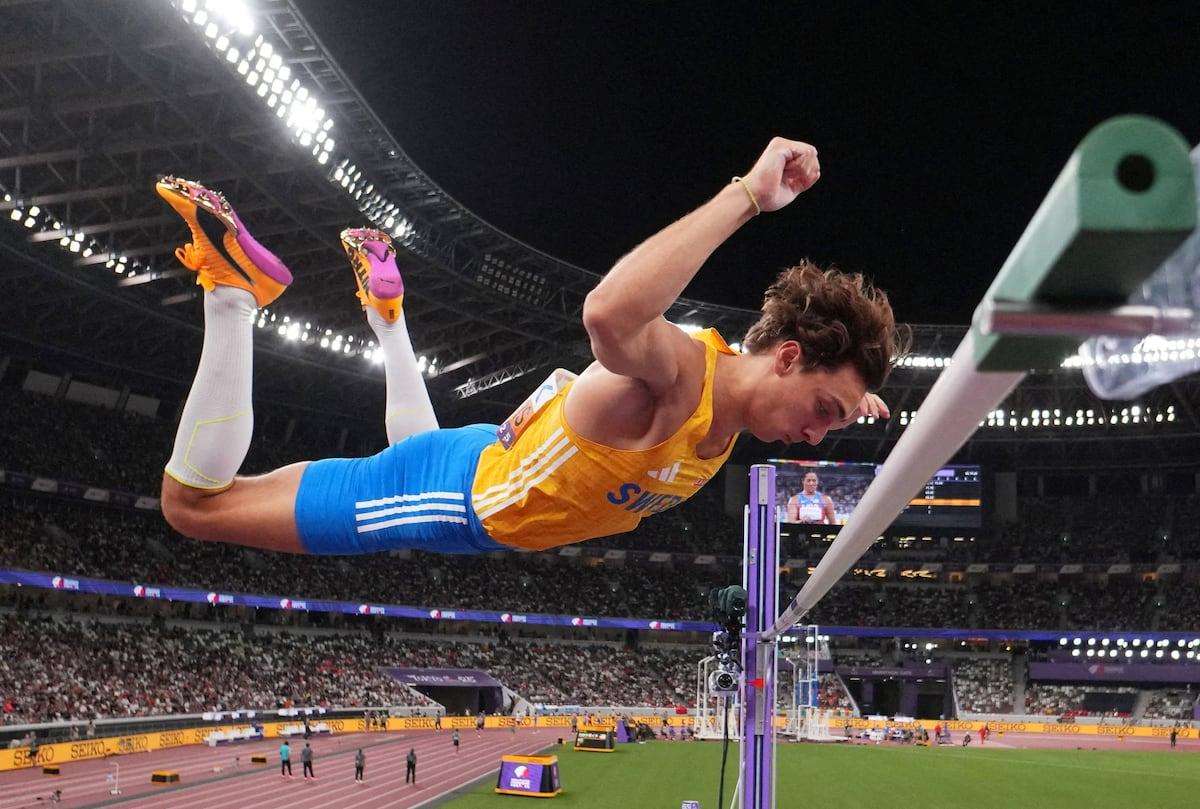
Interview with a Swedish athlete: "Fear is what separates the best and greatest jumpers"
World's Greatest Athlete Mondo Duplantis: "We're playing a game. We're trying to win a game."
Interview with a Swedish jumper: "Fear is what separates the good jumpers from the great ones"
Bahamontes, a man with big hands who measured people by the size of their paws by shaking them and looking into their eyes, and the bigger the paws, the sportsman, he said, would prefer Mondo Duplantis, who claps his kind, big, strong hand to introduce himself, eyes like laughing almonds."Hello, my name is Mondo."And then, those same big hands that firmly hold the fantastic sticks before sticking and bending them like no one knows, quickly and skillfully handle the sticks during the Japanese meal that Sebastian Coe, the president of World Athletics, invites them to in Monaco.He does it with the same precision and the same agility with which the boy Wolfgang Amadeus made his fingers dance on the keys of the harpsichord, and it is not for nothing that many call the Swede the Mozart of the pole.The next day, in old-fashioned chivalry, the same fingers gently pinch the illusion tulle of the long dress of his daughter, the Swedish model Desiré Inglander ("my future wife"), to lift her just enough so that her train, a cloud, does not sweep the shiny floor of the great halls of the Monaco Yacht Club.There, during the gala dinner, Prince Albert presented him with another trophy for the world's best sportsman of the year.Duplantis does it all and is still a chameleon reminiscent of Mozart with the crystalline and powerful smile of Amadeus, the Little Prince with his neck barely in the clouds from inexhaustible and naive curiosity, and the relaxed and loved, carefree Timothee Chalamet, before he became a fierce warrior.They named him Armand, but to the world and to himself he is Mondo. "My father's best friend is from Sicily and he started calling me Mondo when I was four years old because "I know it means world in Italian and I really like it. It connects me to the way I am.""I've been using the facilities for at least 10 years and I felt it was time to start them again," says the athlete, who was born in 1999 in Lafayette to an American father and a Swedish mother and whochose to compete for the Scandinavian country."I was restless, I needed to feel almost like a child again. My grandfather was scared, he was adamantly against it, but I have enough confidence in my jump to know I can do it."
Ask.Have you ever been afraid?
answerFear separates the good jumpers from the greatest.It's that part of fear and mental strength, I'd say, and of course I have a pretty good handle on it, but I think in my mind what really separates me from other people is that I'm still level and I'm still doing what I'm doing and I'm not... I'm crazy enough, but not crazy enough to stop thinking.I can still use my mind and think through situations.Because there are some pole vaulters who are very good without fear, but they are very crazy.They don't think, they just do everything.And there are many who are mentally blocked due to fear.But for me, no, it's not my problem.
Q. Where did that peace come from, the need to feed your childhood?
A. That yard is where it all started.I remember being very young, five or six years old, a kid with a lot of ambition and a lot of dreams and a lot of things that I wanted to achieve, and then I go back there and dance as someone who achieved all the things that I wanted to do as a child... All of that helped me to do everything that I was able to do.
Q. Is your goal to become the best in history or is your challenge simply to surpass the thresholds your father surpassed?
A. I would say both things at the same time.He had big dreams and ambitions and he wanted to be the best of all time, he wanted to be the best there ever was.But it was also an internal competition with myself.I always wanted to be the best I could be and I always wanted to feel like I was improving and progressing.
Q. You can become the best in history at the age of 15... You are in all age categories, juniors, juniors, juniors, juniors, 23-year-olds, seniors... You have not won for two years. He has broken the world record 14 times.He is a two-time Olympic champion.He was always the best.
A.You have to get used to it because sports will find a way to finish you.Ego can be destructive.You have to respect how difficult it is to go out day after day, be consistent, and be at the top.I know how hard it is and how quickly things can change, so I try to be grateful and focus and understand what is good for me and always feed it and never stray from it.it's not easy, you just get better at managing the hard parts.You can never let your ego make you think that sport is easy, because it never is, so you must always be humble and humble.
Question: What are your limits? But I think after seeing him in Paris and Tokyo, after winning the Olympics and the world championships, breaking world records, are there limits?
A. No, I don't think so.Limitation is where I put it.Wherever it ends.
Q. You are 26 years old, do you have the ability to get faster, stronger and improve your technique?
Answer: Yes, in all of themI think I'm going to get better and better and make bigger and bigger leapsYes, I am sure of it
Ask. Your first world record was 6.17m and cm/cm, you held it at 6.30m for six years... Isn't there great economy in this exercise of going cm by cm?
A: The most common explanation I give inch by inch is that every time I break the record, I get a cash bonus.This is not a lie.It's true, yes.It's a factor that comes into the calculation, but it's not the only one.Breaking the record is a unique moment that I can give to the public, to share with everyone.And when I do, people don't care if it's an inch or ten centimeters... They just want to see something, what nobody's seen before, to see me push the limits, even if it's just an inch [and he puts his thumb and forefinger together to show how little it is], and I can share that with the audience... Also, when I break the record for the first time.I never practice records in training, the most I jump is about 20 centimeters less.You can't dance both in training and in competitions, because the energy from the crowd is missing, which gives me the speed I need.It's not true that you can jump 6.40 meters in training, but try 6.30 meters to earn more money.It's a lie.
P. Antes que usted, el ucraniano Serguéi Bubka batió su primer récord del mundo con 5,85m en 1984, y nueve años después lo había elevado, centímetro a centímetro, hasta 6,15m… Si pudiera competir contra alguna leyenda del pasado, ¿a quién elegiría?
A. I guess I'd have to say Bubka, right? It was great to be able to compete with him when he was at his best.He probably thinks he has a chance to beat me, but I don't.
K.Watching yourself with binoculars every minute of your three or four hours at the Paris Games and Tokyo Worlds made a big difference.In Paris he was very relaxed waiting for everyone to finish, changing his shoes, talking to his parents... and in Tokyo Manolo Karalis [6m silver medalist, Greek champion, silver medalist] sat in the cone the whole time, cooling him with a mini fan, and he did great on both occasions.His Paris seemed magical, but the atmosphere of friendship between rivals and the suspense of Tokyo overcame it ...
A. It's true, it's true, but you don't understand how special everything is until you talk about it to other people, because for us it's so natural, so normal ... People like Manolo and Sam Kendricks, who are really incredible people, with big hearts.Of course we want to compete and beat each other on the track, but we have a lot of respect and love for each other and we are like brothers, so we have sports administration and respect for each other.Being, where you can always lend a helping hand.No one gets hurt.It's not like football.Here we all just go against the ball.It is against the ball.This is a competition.Competition does not have to be between us.
P.Interestingly, Alcaraz and Siner, the best in tennis, also declare their friendship after every match... Maybe generational?
A. Yes, maybe. But maybe before he can be friends like that. There is a way to find a balance between having a kind of brotherhood, having a good relationship and being good friends, or even being friends like we are, and at the same time being competitors, wanting to beat each other in the game. Because in the end, I think that's the main story. It's a game. We're only playing games and we're trying to win games. We doit's the highest in the world and the number is high and there is a high price, but it's just a game.
D. Few champions accept being a reference outside the sport, accepting matches, giving their opinion on issues such as climate change... Don't you think we still need to talk about these things?
Answer: Yes.It is important that people speak out what they believe in and talk about things they believe are important and good for the world and society.In my particular case, I'd say I found a lot of things I've been to.I think the only problem with talking about a lot of things is that, in a way, perspectives are changing and I think it's different than yesterday because I'm younger and I'm learning more every day and I'm learning about the world and I'm learning more about life and I'm learning more about what I want and what I believe and what I like.But I think it’s important to tell the truth.Say what you believe and want.If there is an issue like: climate change or any other issue that you are passionate about and truly believe in, you should absolutely speak out.If there's something I don't talk about, it's because I don't feel the need to, I'm focused on other things in life, and I believe you can only do what you can do.
Q. In your Louisiana, 20 years ago, Hurricane Katrina was like a preview of the disaster to come... you were five years old, what do you remember?
Answer - Displaced part of my family.He had family in New Orleans and had to move to Lafayette.It was very tragic.Very tragic and very dangerous for society.New Orleans is still recovering.It may never fully recover, and it never has.I remember the impact it had on some people and a loved one.It was one of those devastating things where you close your eyes and wish it wasn't real, but I was too young at the time to fully understand it.
Your subscription is active on another device
Do you want to add a user to your login?
If you continue to read on this device, it cannot be read on the other device.
Arrow Your membership is being used on another device. You can only access EL PAÍS on one device at a time.
If you want to share your account, upgrade your subscription to Premium status, so you can add another user.Everyone will log in using their email account, allowing you to personalize your experience at EL PAÍS.
Do you have a business subscription?Go here to sign up for multiple accounts.
If you don't know who is using your account, we recommend changing your password here.
If you choose to continue sharing your account, this message will appear on your device and on the device of the other person using your account, affecting your reading experience.You can view the digital subscription terms here.
About the signature
Carles Vilarrubí, businessman and founder of Catalunya Ràdio and Barça vice-president, dies aged 71
Brigitte Bardot, life in images
The families of four missing people in Indonesia are calling for the search to continue until they are found
Actress Brigitte Bardot, who was an inspiration for French cinema and a controversial activist, has died at the age of 91.
More visits
- The great defeat of Gordo de Navidad in Villamanín, 15 young people aged 18-25: "Today we lost our friends"
- If only one winner Gordo de Villamanin decides to report?
- Europe entered a state of alert before Trump's strategic attack
- Mountaineer Simon Moreau survived a heart attack at 5,000 meters and announced the creation of an air rescue service in Pakistan's Karakoram.
- Agreement of Villamanín for El Gordo without distribution: the Festival Commission gives more than two million for the peace of the city.