

 Dec 29, 2025
 3 min read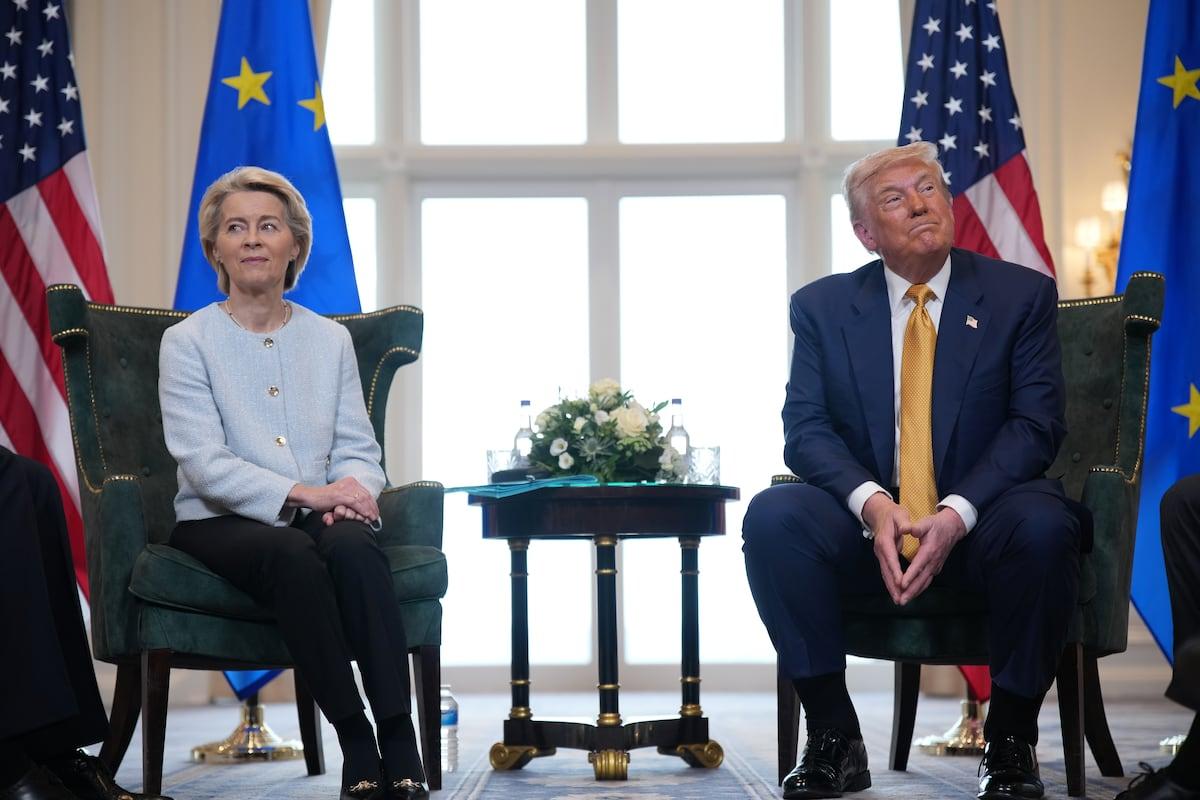
Signs of U.S. hostility, such as threats to Greenland, sanctions on personnel and a new security strategy, are heightening tensions in a Europe that remains dependent on Washington.
Europe has entered a state of emergency due to Trump's strategic attack.
Signs of hostility from the US, such as threats against Greenland, sanctions against individuals and a new security strategy, have raised tensions in Europe, which is still dependent on Washington.
Not only does the United States not want to shoulder the burden of being the guarantor of the continent's security, it also displays open hostility to Europeans in areas beyond simple economic and technological competition, and is deeply affecting strategic and security issues.
Last Monday, the president of the United States, Donald Trump, said that his country needs Greenland - an independent territory of Denmark, a Pacific partner - for reasons of national security, and a new special envoy appointed to deal with the matter wants to "lead the governor"."We got it," Trump said.
At the beginning of the month, Washington published its new National Security Strategy, in which it launched a blunt attack on the EU, describing it as an entity that "destroys political freedom" and "promotes censorship and repression of political opposition", promising to "cultivate resistance", meaning a campaign of support for nationalist forces in Europe that aim to dismantle the integration project.
Another serious example of hostility emerged this week when Washington imposed sanctions on former European Commissioner Thierry Breton, who was previously in charge of technology regulations on online content moderation and hate speech, and leaders of organizations that fight against banned and extremist content.This is another round of pressure from Washington on Brussels to ease the rules on American companies and to favor the techno-oligarchs who are now part of the ecosystem of Trumpism.
The US initiative, although not imposed on powerful political leaders, is "very important", a senior social source said.
These episodes are examples of a hostile attitude of the United States toward Western Europe that has not been seen since the end of World War II.There are others.From threats or suggestions to withdraw the security umbrella that covers NATO allies – the United States provides enormous capacity and leadership to this organization that is irreplaceable today, but also to the questionable nuclear deterrence of a trade war.
Nathalie Tocci, director of the Istituto Affari Internazionali warns: "When it comes to Europe, Trump and his administration have shown great solidarity and foresight: they want to destroy us."The expert says: "Today, the United States sees liberal democracy and European integration as enemies."
It's not all bad news from Washington for Europe.This month, the US Congress approved the 2026 budget for the Pentagon, which includes measures that move away from Trump's policy and seek to strengthen security ties with Europe.The legislative text includes, although small aid for Ukraine - 800 million aid - spread over two years - and, above all, provisions limiting the ability of the Department of Defense to reduce the 76,000 US troops in Europe (the estimated 84,000 at the beginning of this year, which was prohibited by the head of the European Council on Foreign Relations of the United States).The title of NATO Commander-in-Chief.
The legislation demonstrates that there continues to be a broad consensus within the American political establishment as well as the military about the strategic importance of maintaining a strong defense relationship with Europe.However, unlike in Trump's first term, these positions are not represented in his administration.
Because of these facts, even the most Atlanticist European countries are returning their calculations to understand the serious danger of relying on American support. The Danish military intelligence services had no choice but to describe the US as a potential threat to its national security."The US is using economic power, including threats of strong tariffs, to impose its will.
If the hostility of the US is added to the activities of Russia, which continues its aggression against Ukraine and deepens its sabotage actions in Europe, the perception of risk increases.
The main key that drives European states to be cautious is the heavy dependence on the United States in terms of security.This directly affects the ability to protect private individuals.And one indirectly to strengthen the position of Europe in all areas related to Washington.
EU countries invest significantly more in defense, at around €380 billion in 2025, nominally more than China or Russia – though not in terms of purchasing power parity.
However, this number is a mirage that does not translate into a truly deterrent autonomous defense capacity.Among other things, because Europeans are dependent on the United States in key aspects of performance and because total spending on paper circumvents a reality characterized by national fragmentation.The only effective coordinating element is NATO, which is dominated by the United States of America.
Dependence is quantitative - with limits on the production capacity of weapons and industry - and qualitative.
A report by the International Institute for Strategic Studies said the Europeans depend on the US for critical issues such as intelligence, surveillance and reconnaissance, for which they lack sufficient air and space resources.Other hardware deficiencies relate to the lack of sufficient anti-aircraft and long-range missile capabilities.For example, the software industry lacks sovereign cloud computing power.In the nuclear industry, there are two countries that have capacity (France and Great Britain), but whose arsenals are much smaller than those of Russia and the United States.
In a clear connection between Washington's leadership in the attack on Europe and the issue of defense, the Vice President of the United States J. D. Vance said in a recent conference: "France and the United Kingdom have nuclear weapons. If they go beyond the moral strategy, then nuclear weapons will be allowed to enter the hands of those who can do great harm to the United States."
In this context of American aloofness and boredom, the alarm was caused by the exclusive information of the Reuters agency in early December, according to which Washington wants Europe to take over the conventional defense capabilities of the continent by 2027.The message, according to news reports, was sent by Pentagon officials to several European representatives at a meeting in the US capital.
The 2027 date has fallen flat in some circles.However, the United States has not formally or informally informed all allies of this intention, NATO sources said.Moreover, the same sources state that it is "very difficult" to make this move in the short term.Raising the issue seems set to hasten a disintegration that will change NATO forever.
Another report by the International Institute for Strategic Studies estimates that European states would need to invest about $1 trillion more than current levels to replace conventional capabilities—that is, excluding nuclear capabilities—that the United States has committed to the Euro-Atlantic scenario to cover a 25-year defense cycle.
Jamie Shea, a researcher at the Friends of Europe think tank and senior NATO official until 2018, emphasized that it is not realistic today for the Europeans to be autonomous in terms of capabilities, defense spending and the issue of nuclear deterrence." "But the effort must continue, even if the US posture becomes less hostile," he says. "The old Cold War United States is not coming back," says Shea.
Luis Simón, director of the Brussels office of the Elcano Institute, believes that it is very likely that US capabilities and presence in Europe will be reduced as Washington wants to focus on other scenarios, but he does not believe that it will be comprehensive.
"Today, the Europeans are not able to maintain a command structure with all that means, and they will not be in the next five or ten years. They do not have the technical skills and there is no government with the political right to replace the United States," Simon says.it can lead to formation," say experts.
“The bottom line is that the United States looks to Europeans to take care of its defense, but the Trump administration has chosen the strategy of wanting to isolate Europe, led by strongmen, thus hindering the generation of European resources, either under the auspices of the EU or as a European pillar within NATO,” said Pol Morillas, director of the CID.
This political attitude, this hostility, casts a shadow over the weapons that Europe has at its disposal.The specter of kill switches, mechanisms by which manufacturers can remotely disable operations, haunts the region.Far from being completely disabled, interruptions in the delivery of operational software updates can seriously jeopardize the ability to operate key components such as F-35 fighters or European navies.with the Aegis system.
This report is made in an unofficial environment.Data compiled by Juan Mejino-López and Guntram B. Wolff of the Bruegel Institute show an increase in purchases from the United States in recent years.European NATO countries spent 50% of their money on military equipment buying it from the United States in 2022-24, compared to 28% in 2019-21.
"It makes sense if you take into account the threat situation in Europe, the war in Ukraine. A relevant part of the purchase is directed to the US defense industry because the production capacity in Europe is small," says Magino López.
But on the way out of this dependence, there is not only ideological resistance of nationalists, but also friction of national interests with small but serious consequences.Morillas, author of On the Elders' Porch.Europe in the face of an adversarial world (Debate), for example, points to the failure of the FCAS project, a next-generation fighter jet system that was supposed to be developed by Dassault, Airbus and Indra, but which has been weakened by disputes between France and Germany.
All this does not mean that Europe will not take significant steps forward.When Russia invaded Ukraine in 2022, EU military spending increased from 260,000 million euros to 380,000.Many countries introduced new mechanisms to increase the number of military personnel.Agreed to an exemption from the Fiscal Stability Pact for military investments.
In the same way, the industrial sector has taken steps to increase its production capacity in recent years, while the core of European countries has established informal councils at the political level and has had some influence on negotiations regarding Ukraine.
Many analysts believe that for progress, it is necessary to abandon plans that require consensus and build coalitions of volunteers."It's the only way I can do it, outside of the established structures, by agreement," Morelas says.This is very similar to the practical federalism that Mario Draghi talks about.
A case in point is the recent loan to Ukraine by issuing Eurobonds without the involvement of Hungary, the Czech Republic and Slovakia.
As a first priority to reduce dependency and great vulnerability, Europe should try to replace the 20,000 troops that the United States sent to Ukraine at the beginning of the crisis and who will in all probability leave (Washington has already withdrawn from part of Romania), suggests a report from Harvard University's Belfer Center in which researcher Daniela Schwarzer participated as a coordinator."Many people could face military defeat, and the security and prosperity on both sides of the Atlantic could be dealt a blow," he said.
Your subscription is being used on another device
Want to add another user to your subscription?
If you continue reading on this device, it will not be possible to read on another device.
Arrow Your subscription is being used on another device, you can only access EL PAÍS from one device at a time.
If you want to share your account, change your subscription to premium mode so you can add another user.Each will log in with their own email account, allowing you to personalize your El País experience.
Do you have a business subscription?Go here to sign up for more accounts.
If you don't know who is using your account, we recommend changing your password here.
If you decide to continue sharing your account, this message will appear on your device and the device of the other person using your account indefinitely, affecting your reading experience.You can see the terms and conditions of the digital subscription here.
At least 13 people were killed when an Intercontinental train derailed in Oaxaca
The elections were easily won by nationalist Albin Kurti, the current Prime Minister of Kosovo
At least 13 people were killed when an Interoceanic train derailed in Oaxaca
Kyrgios wins mock tennis battle of the sexes against Sabalenka in Dubai
Most viewed
- Europe goes on high alert before Trump's strategic attack
- What happens if only one of the winners of the Gordo de Villamanín decides to come forward?
- Villaman's Corto de Navidad won over the elderly, 15 young people between the ages of 18 and 25: "Today we lost friends"
- The shadow of the only child: China pays for its greatest social experiment with a demographic crisis
- The direction of the PP with Vox: of promising not to govern with the extreme right to normalizing it after the result in EXTRMADURA